Claude Duet opens US preview for proactive briefings and cloud tasks
Anthropic’s new assistant can check connected apps and continue work in the cloud. Its US Pro/Max preview adds approval-based purchases, but access, integration gaps and shared usage limits constrain the launch.
In this article
- Quick answers
- A preview that starts the conversation
- Existing context, a different working rhythm
- One subscription allowance covers active and background work
- Connected apps have specific boundaries
- Purchasing adds a separate approval step
- Disconnecting access is different from clearing memory
- Sources & method
Quick answers
Who can use Claude Duet?
Invited US Pro and Max subscribers. It is a research preview on iOS, Android and claude.ai; Team and Enterprise are excluded for now.
Does Duet have a separate usage allowance?
No. Background checks and assigned work share the subscriber’s Claude limits. There is no additional Duet fee during the preview.
Can Duet pay through Link without approval?
Anthropic says Link payment requires approval of the amount in Link. It needs a US payment method and does not support recurring payments.
The practical takeaway
Duet adds proactive follow-up to an existing Claude account, but admission requires a US Pro/Max waitlist invitation and background work consumes the same allowance as other Claude use.
A preview that starts the conversation
Anthropic opened a waitlist for Claude Duet on October 21, introducing an assistant that checks connected apps, brings users a morning briefing and keeps working on assignments in the cloud. The research preview starts with US Pro and Max subscribers; joining the queue does not guarantee an admission date. Team and Enterprise accounts are not included.
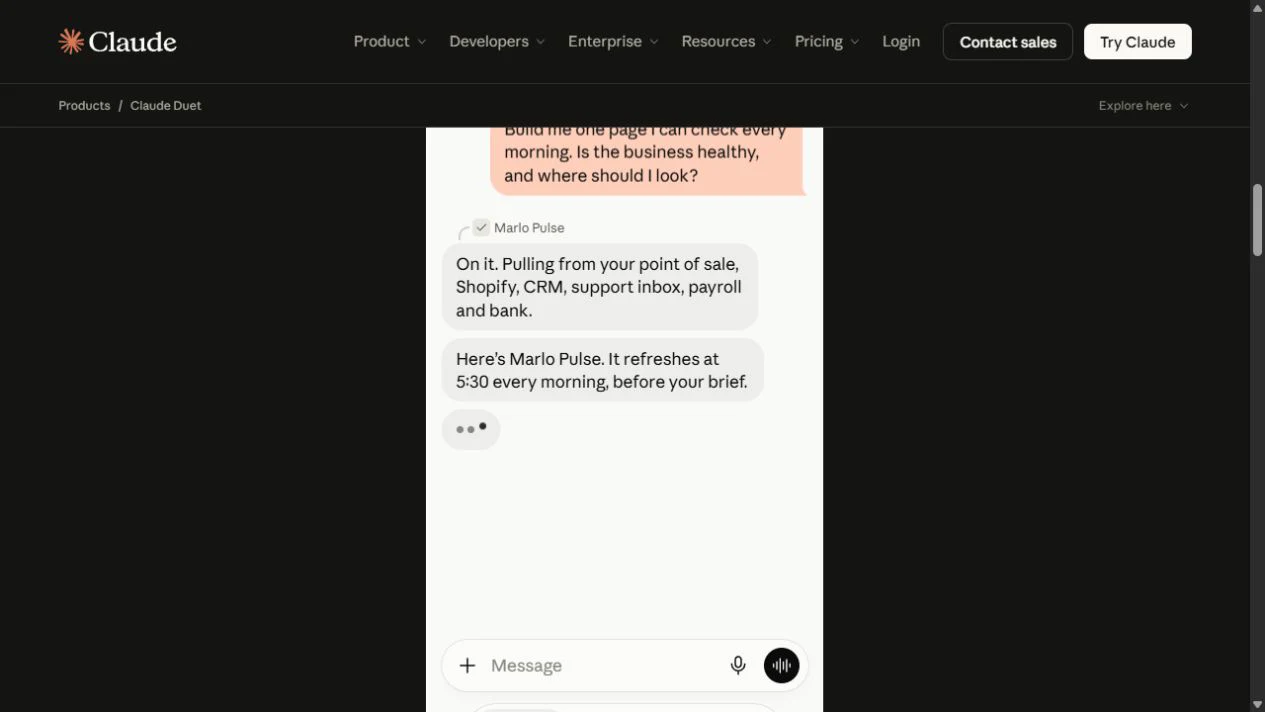
The useful change is proactive follow-up: Duet can surface work before someone opens a conversation. Anthropic says it checks accounts every few hours, rather than continuously, to conserve usage. That makes it a potential aid for routine coordination, with gaps between checks that matter for urgent work.
Existing context, a different working rhythm
Duet carries over a Claude account’s memory, skills and connected apps. Users give it written or recorded voice messages, and its cloud computer can continue an assignment after their own devices are off. It runs on Opus 5.5. Anthropic offers separate iOS and Android apps plus access through claude.ai.
Claude’s current paid offering already includes handing off and scheduling tasks. Duet brings that work into an ongoing conversation with updates initiated by the assistant. Anthropic’s product examples include finding unpaid invoices and preparing reminders, as well as producing decks and dashboards.
Consider the documented invoice workflow: the Stripe connector supplies account information, and Duet prepares reminder emails for approval. Link, also from Stripe, serves a different purpose—it pays for purchases. Connecting a business account to inspect invoices does not by itself set up a payment wallet.
One subscription allowance covers active and background work
During the preview, Duet has no additional subscription fee. Claude Pro costs $20 when billed monthly or $200 paid annually; Max starts at $100 a month. These prices exclude applicable taxes. Paying for an eligible plan still leaves the waitlist invitation requirement.
Morning briefs, background checks and larger assignments consume the same allowance as other Claude work. Paid accounts have both a five-hour session limit and weekly limits, with consumption affected by task complexity, model and tools. In practical terms, unattended work can leave less capacity for an interactive session later.
Anthropic’s Duet guide also lists a one-time full reset of session and weekly limits when a user is admitted, available until November 30, 2026. It does not establish an ongoing extra allowance.
Connected apps have specific boundaries
Duet’s product page displays a Microsoft/Office 365 logo, but its help guide says Microsoft 365 is not available yet and flags Slack limitations without detailing them. Users cannot watch or take over Duet’s browser, access local computer files through it, or have it place phone calls or send texts. Anthropic also cautions that Duet can misread threads and misjudge urgency.
Anthropic’s general connector guide says ordinary connections inherit the user’s permissions in the source service; custom connections using shared credentials reach what those credentials permit. Linking an app can enable both retrieval and changes, within those permissions. For a business owner, the account used for a connection determines which records the assistant can reach.
Purchasing adds a separate approval step
Anthropic says Duet is designed to request approval before sending messages, paying, signing documents or deleting material. Securities trading and transfers between accounts remain prohibited even with approval. These are stated safeguards, not protections AI Toolcast has independently tested.
The Link guide provides a concrete purchasing sequence: Duet finds an item, the user approves a spending request through Link, and checkout uses a single-use card restricted to the merchant and amount. A US payment method is required. The wallet is connected within Duet, separately from the connectors directory.
Approval does not guarantee checkout. A merchant can still decline or block the transaction, a failed purchase can temporarily remain pending, and recurring Link payments are unsupported. In a hypothetical office-supply reorder, a blocked checkout could leave the user to complete the purchase.
Disconnecting access is different from clearing memory
Duet’s guide says disconnecting an app stops future access but retains information remembered from earlier conversations. Claude’s memory documentation distinguishes that stored context from chat search: deleting a conversation does not automatically remove memory entries derived from it.
Users can inspect, edit or delete saved topics in Settings > Memory. The separate Search and reference chats switch also controls Duet’s ability to search earlier conversations. Those controls matter because the same continuity that reduces repeated explanations can carry information forward after the original connection or conversation is gone.
Sources & method
AI-assisted reporting based on Anthropic’s announcement, product pages and implementation guides opened on October 22, 2026. Capabilities and safeguards are vendor descriptions; AI Toolcast did not test Claude Duet.
- Anthropic: Introducing Claude DuetPublished October 21, 2026
- Claude Help Center: Get started with Claude DuetAccessed October 22, 2026
- Anthropic: Claude Duet product overviewAccessed October 22, 2026
- Claude Help Center: How do usage and length limits work?Accessed October 22, 2026
- Anthropic: Claude pricingAccessed October 22, 2026
- Claude Help Center: How to use Link by Stripe with Claude DuetAccessed October 22, 2026
- Claude Help Center: Use Claude’s chat search and memory to build on previous contextAccessed October 22, 2026
- Claude Help Center: Use connectors to extend Claude’s capabilitiesAccessed October 22, 2026
Source pages reviewed October 22, 2026. Analysis and suggested evaluation methods are AI Toolcast’s own.
This AI-assisted report contains no sponsored placement or affiliate links. Claude Duet was not tested for this article.
Found a possible error? How to report a correction.
Keep reading
Claude Security adds ongoing scans and automatic fix tracking
Anthropic’s Enterprise security beta now follows code changes and connects findings to engineering tools through an API and MCP. Plan-specific access, usage billing and migration limits shape adoption.
Mistral launches Voxtral 3 voice agents with limits on phone access
Voxtral 3 packages speech and tool use for conversational apps. Implementation guides reveal consequential differences between browser and phone deployments, including enterprise-only telephony, inbound calls and no live transfer to a person.
Claude Code Review leaves preview with adjustable review depth
Anthropic's hosted pull-request reviewer has left preview. Repository-level depth controls give teams more choice, while review frequency, eligibility restrictions and separate billing shape the rollout decision.