IBM expands Granite Speech with multilingual Turbo CTC and a new 2B model
IBM's October update adds Speech 5.0 2B, makes Turbo CTC multilingual and revises Plus. Language coverage, speaker labels and audio-processing limits differ across the downloadable models.
In this article
Quick answers
What changed in Granite Speech?
IBM introduced Speech 5.0 2B, expanded Turbo CTC to seven transcription languages and updated the weights of Speech 4.1 2B Plus.
Which model handles speaker labels?
Speech 4.1 2B Plus provides speaker-attributed transcription and word timestamps. It does not provide punctuation or capitalization.
The practical takeaway
Granite Speech offers distinct models for translation, fast transcription and speaker-attributed output. The 2B model's segment-length and quantization guidance matter for deployment.
Three updates for different speech jobs
IBM announced a Granite Speech update on October 21 that adds a new 2-billion-parameter speech-language model, expands its smaller Turbo CTC transcriber beyond English and revises its model for assigning speaker labels and word timings. The downloadable models target developers building transcription, translation and recording-analysis applications.
The release combines three separate changes. Speech 5.0 2B's model card dates its release to October 20; Turbo CTC's multilingual revision is dated October 21, while the Plus weights were updated October 19. IBM brought them together in the October 21 announcement.
What the new 2B model actually adds
Granite Speech 4.1 2B already supported multilingual transcription, translation, vocabulary hints and formatted text. The new model keeps the same parameter count. IBM identifies larger keyword lists and an explicit input-language prompt as additions, and reports improvements on difficult acoustics and longer conversational translation.
The core transcription languages remain English, French, German, Spanish, Portuguese and Japanese. Translation connects English with the other five, with English-to-Italian and English-to-Mandarin also supported. Applications need to stay within those specified translation directions.
Keyword lists can now contain up to 2,000 terms. A hypothetical equipment-support application could supply product names and abbreviations before transcribing a recording. This steers recognition toward relevant vocabulary; it does not establish that every supplied name will be recognized correctly. The distinction matters when a plausible transcript contains the wrong part number.
Turbo CTC gains languages without a language-model decoder
The 470-million-parameter Turbo CTC model now transcribes English, French, German, Spanish, Portuguese, Italian and Japanese, and produces punctuation and capitalization directly. Its October revision follows an English-only release in August. The current implementation guide specifies Transformers 5.16.0 or later.
Turbo CTC takes a different route from the 2B model: it uses an acoustic encoder without the accompanying language-model decoder. IBM's original explanation identifies the tradeoff as faster transcription while giving up speech translation and keyword biasing. The multilingual revision retains the encoder-only architecture and expands its output vocabulary.
IBM positions the smaller model for straightforward speech-to-text workloads, including device-based applications. The architectural tradeoff matters if an application also needs translation or terminology control.
Plus handles speaker labels and word timing
Speech 4.1 2B Plus retains its interface while updating the weights. It transcribes English, French, German, Spanish and Portuguese, without punctuation or capitalization. Speaker numbers follow first appearance rather than identifying people by name.
Word-end timestamp tags roll over every ten seconds, requiring the application to reconstruct elapsed time. IBM's reported evaluation ranges extend to nine-minute segments for transcription and speaker attribution, and 3.5 minutes for timestamps.
Downloadable weights still need a deployment plan
For Speech 5.0 2B, IBM recommends dividing recordings into segments of roughly two minutes or less; its Transformers example checks for 16 kHz mono audio. The llama.cpp guidance recommends Q8_0 quantization. IBM reports that lower-bit versions lose accuracy on audio longer than about a minute. These are deployment recommendations and vendor findings, not limits independently tested by AI Toolcast.
All three releases carry Apache 2.0 licenses, permitting commercial use subject to conditions that include keeping required notices and supplying the license when redistributing. Computing and hosting remain separate costs. The older Turbo CTC -nc variant instead carries a noncommercial license; the suffix matters when selecting a repository.
Our reading is that the release offers useful building blocks for self-hosted transcription. Audio preparation, model selection and the application's handling of the resulting text remain part of the implementation.
Read the benchmarks by task and test set
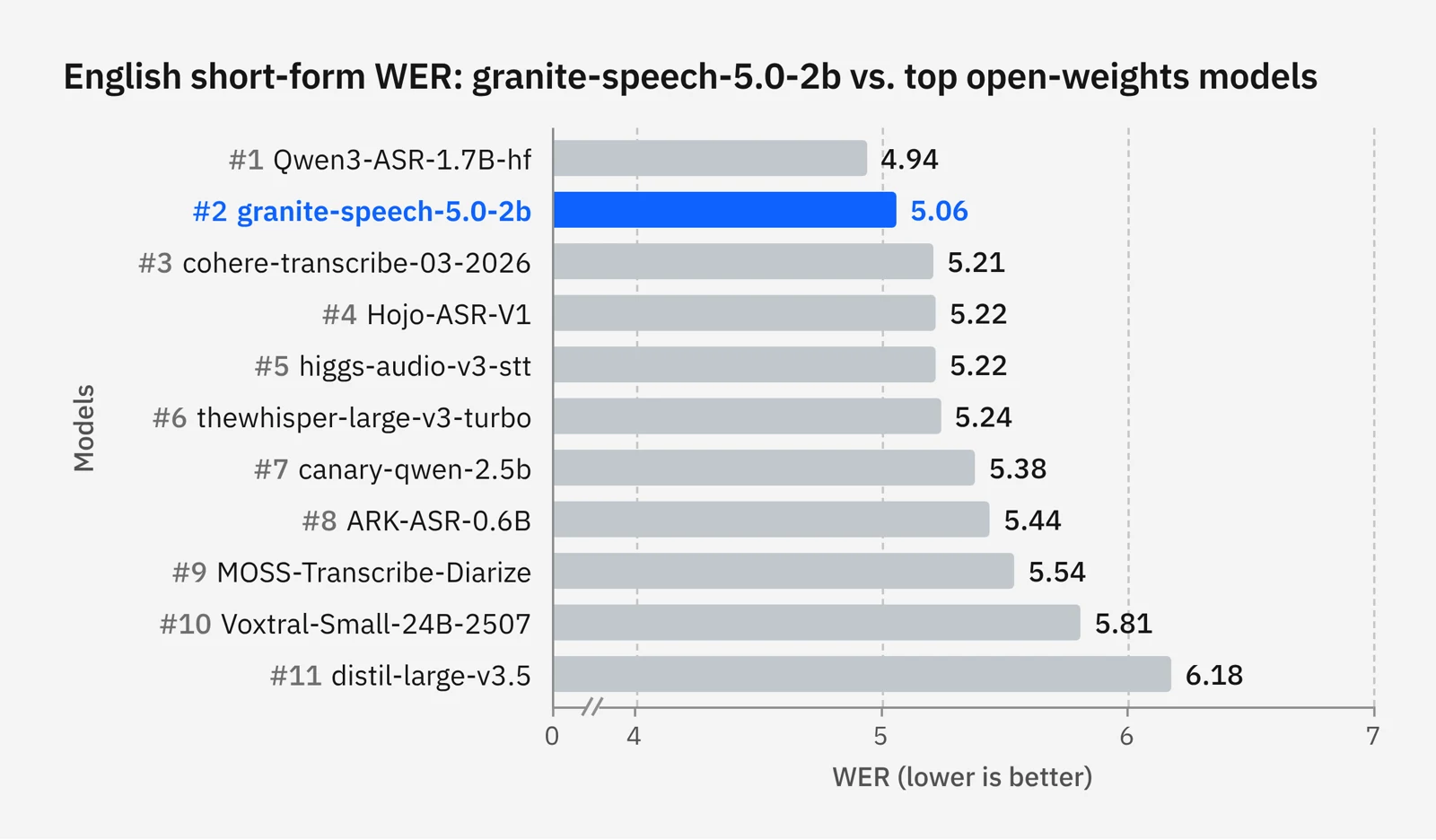
IBM reports a 5.06% average word error rate for Speech 5.0 2B on the Open ASR Leaderboard's public English short-form test sets as of October 21. That result describes a particular transcription evaluation; it does not measure translation or speaker attribution.
Turbo CTC's card labels its multilingual speed-versus-error point unofficial while the leaderboard entry still represents the English-only release. Plus's side-by-side comparison, with both versions evaluated on the same revised test sets, reports average word error rates of 6.01% for the earlier weights and 6.10% for the update. Lower is better.
Plus's documentation also warns against comparing historical leaderboard scores across changed test sets. Better timing or vocabulary recognition therefore should not be read as improvement on every transcription workload. All these results are IBM's reported evidence; we have not reproduced them.
Sources & method
AI-assisted reporting from IBM's announcement, current and earlier model documentation, and the Apache 2.0 license, with original analysis. We did not run the models or independently verify IBM's performance results.
- IBM: Granite Speech 5.0 release announcementPublished October 21, 2026
- IBM: Granite Speech 5.0 2B model cardPublished October 20, 2026
- IBM: Granite Speech 5.0 470M Turbo CTC model cardPublished October 21, 2026
- IBM: Granite Speech 4.1 2B Plus model cardPublished October 19, 2026
- IBM: Granite Speech 4.1 2B predecessor model cardPublished April 29, 2026
- IBM: Original Granite Speech 5.0 Turbo CTC announcementPublished August 25, 2026
- Apache Software Foundation: Apache License, Version 2.0Accessed October 23, 2026
Source pages reviewed October 23, 2026. Analysis and suggested evaluation methods are AI Toolcast’s own.
This article contains no sponsored placement or affiliate links.
Found a possible error? How to report a correction.
Keep reading
OlmoEarth v1.3 adds browser mapping with reusable satellite data
Ai2’s new release combines precomputed satellite features with a map explorer that requires no account. Annual coverage, local setup requirements and restrictions on permitted uses shape where it can be deployed.
Inception releases Mercury 3 with a larger context and changed reasoning default
Mercury 3 expands text capacity and changes default reasoning effort as Inception winds down older models for eligible existing users. The migration brings access deadlines as well as API and pricing changes.
Mistral releases Timestral forecasting models for CPUs and GPUs
Mistral's Timestral models forecast numerical histories locally, including uncertainty and related inputs. CPU support lowers the hardware entry point, while the weights carry separate revenue-based license restrictions.