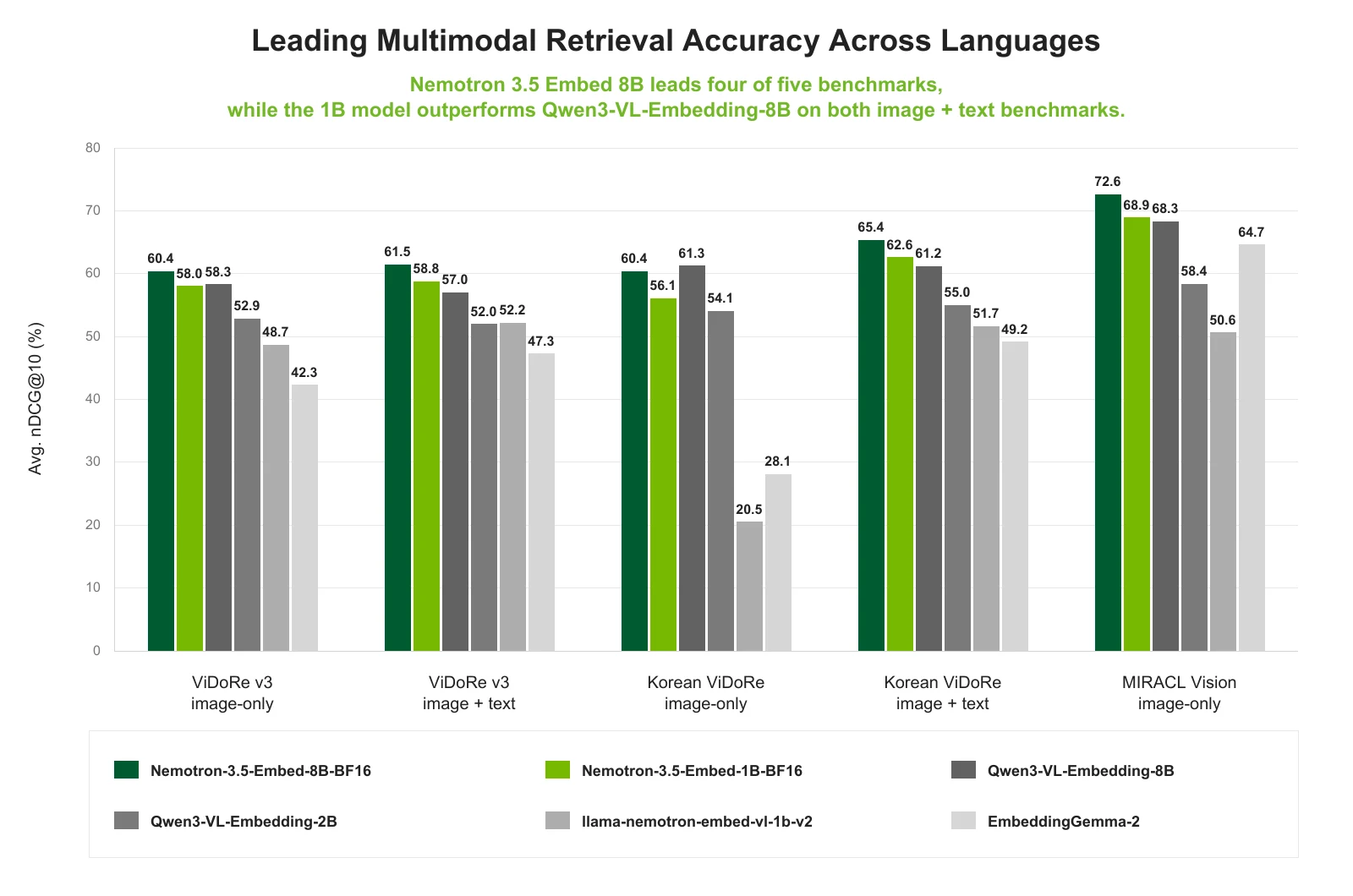
NVIDIA adds document-image search to Nemotron 3.5 retrieval models
NVIDIA’s downloadable Embed and Rerank models extend search across text and document images. Existing text-index compatibility offers a migration path, while the smaller NVFP4 version carries specific hardware and runtime requirements.
In this article
- Quick answers
- Search reaches the information inside document images
- Finding a page and deciding its relevance are separate jobs
- A migration path for existing text search
- The compact option has a hardware boundary
- Parse supplies structure when pixels must become data
- Token savings are a vendor result, not a complete operating bill
- Sources & method
Quick answers
What changed in Nemotron 3.5 retrieval?
The Embed models can represent document images alongside text, and Rerank can score those retrieved pages against a text query. They supply evidence to an application; they do not generate its final answer.
Can an existing text index be reused?
NVIDIA documents matching text embedding spaces for each BF16 embedding model and its corresponding Nemotron 3 Embed predecessor. That does not establish compatibility with unrelated models or differently configured indexes.
Does the smaller NVFP4 version run everywhere?
No. Its model card specifies vLLM and hardware supporting NVFP4, such as NVIDIA Blackwell. It directs Transformers and Sentence Transformers users to the BF16 version.
The practical takeaway
Nemotron 3.5 gives developers a way to add visual documents to retrieval systems while retaining compatible text embeddings. Hardware selection, preprocessing and downstream answer generation remain separate implementation decisions.
Search reaches the information inside document images
NVIDIA announced its Nemotron 3.5 retrieval collection on October 21, adding models that help AI applications find and prioritize evidence in text and document images. The release combines three Embed variants, an 8B Rerank model and a document parser. It targets developers building search and assistants over collections containing charts, tables and scanned pages.
The announcement packages several downloads with different release dates. The Embed and Rerank cards list October 20; the Parse card lists October 17. These are available model components for developers to integrate, with commercial and noncommercial use identified in their cards.
Finding a page and deciding its relevance are separate jobs
Embed converts each document into a numerical representation that a search system can store and compare with a user's question. A document can be text, a page image or both. Queries remain text-only. The 8B model accepts up to 32,768 tokens, so the input budget still constrains how much material an application can supply.
Rerank operates after that initial search. It evaluates a question together with each candidate document and returns a relevance score, allowing the application to reorder the shortlist. Its output is a score rather than a written answer. A higher score indicates a closer match to the question, not proof that the document's claim is correct.
In a hypothetical engineering assistant, the first stage could locate specification pages containing a relevant table; the second could prioritize the page addressing the requested component. Our reading is that this gives developers more control over which evidence reaches the answering model, while leaving the answer and its verification to the wider application.
A migration path for existing text search
NVIDIA says the 8B BF16 model retains the language component of Nemotron 3 Embed 8B and produces identical text embeddings. The 1B BF16 card likewise describes a shared text embedding space with its corresponding predecessor. That is a useful distinction for teams that have already indexed a large text collection: the visual upgrade does not inherently require replacing those compatible text representations.
The compatibility claim is specific. The 1B card documents 2,048-dimensional vectors and supports shorter vectors only with normalization after truncation. Our inference is that an existing deployment still needs to preserve its matching representation and preprocessing settings. A shared family name alone does not make every stored vector interchangeable.
The compact option has a hardware boundary
The 1B NVFP4 variant uses lower-precision weights and activations in both its language and vision components. Its implementation guidance specifies vLLM and hardware with NVFP4 support, including NVIDIA Blackwell GPUs. Developers using Transformers or Sentence Transformers are directed to the BF16 model instead.
The BF16 1B card lists Linux and NVIDIA Ampere, Hopper and Blackwell compatibility. It also documents separate software environments: its Transformers examples use version 5.20.0, while the vLLM examples use Transformers 5.19.0 with vLLM 0.32.0. The card warns that Transformers 5.17.0 through 5.19.0 can produce CUDA errors or incorrect image outputs with Flash Attention 2. These dependencies make runtime selection part of the deployment decision.
Parse supplies structure when pixels must become data
Nemotron 3.5 Parse addresses another part of the workflow. Its approximately 631-million-parameter model turns page images into text with element classes, bounding boxes and reading order. The card describes uses including scanned PDFs, slides, forms and reports. Postprocessing can convert supported table or chart text into formats such as HTML, JSON or CSV.
That output serves a different purpose from a search vector: an application can work with extracted content and its location on the page. Accuracy remains task-dependent. NVIDIA explicitly cautions that its multilingual OCR results on simply rendered synthetic pages do not guarantee accuracy on complex scans, handwriting or degraded images. Broad language evaluation is therefore not evidence that every real document will parse reliably.
Token savings are a vendor result, not a complete operating bill
NVIDIA reports that adding its reranker reduced agent inference-token use by about 14% with the 8B embedding model and 13% with the 1B model in its experiments. Its evaluation used ViDoRe v3, BRIGHT and BrowseComp-Plus, holding the agent, tools, tasks and execution policy fixed while changing retrieval configurations. AI Toolcast has not reproduced these results.
Our analysis is that fewer agent tokens do not establish an equivalent reduction in total spending. Retrieval and reranking themselves require computation, and an application must store and serve its index. The model cards identify commercial use under OpenMDW 1.1, but deploying downloadable weights still leaves those infrastructure costs with the operator. The practical opportunity is more selective evidence retrieval, with economics dependent on the actual workload.
Sources & method
AI-assisted reporting from NVIDIA’s announcement and five model cards, with original workflow analysis. These are vendor sources, not independent performance evidence. We did not run the models or verify hosted-service availability.
- NVIDIA: Nemotron 3.5 Embed, Rerank, and Parse release announcementPublished October 21, 2026
- NVIDIA: Nemotron 3.5 Embed 8B BF16 model cardAccessed October 24, 2026
- NVIDIA: Nemotron 3.5 Rerank 8B BF16 model cardAccessed October 24, 2026
- NVIDIA: Nemotron 3.5 Embed 1B BF16 model cardAccessed October 24, 2026
- NVIDIA: Nemotron 3.5 Embed 1B NVFP4 model cardAccessed October 24, 2026
- NVIDIA: Nemotron 3.5 Parse model cardAccessed October 24, 2026
Source pages reviewed October 24, 2026. Analysis and suggested evaluation methods are AI Toolcast’s own.
This article contains no sponsored placement or affiliate links.
Found a possible error? How to report a correction.
Keep reading
Exa 3.0 adds cheaper agent search, with cached-content limits
Exa’s October 19 release adds Lite search and expands the information available to AI agents. Its implementation guides reveal limits on fresh page retrieval, clearer search warnings and a documentation mismatch over Dynamic Highlights.
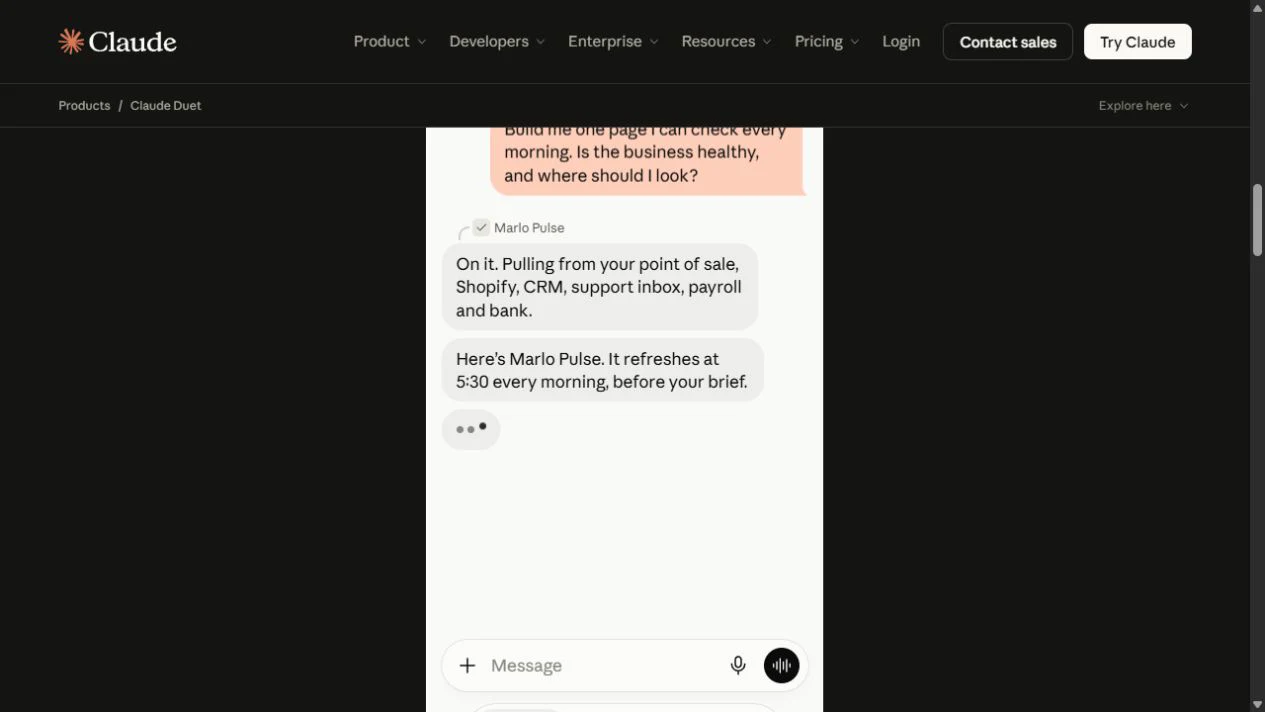
Claude Duet opens US preview for proactive briefings and cloud tasks
Anthropic’s new assistant can check connected apps and continue work in the cloud. Its US Pro/Max preview adds approval-based purchases, but access, integration gaps and shared usage limits constrain the launch.
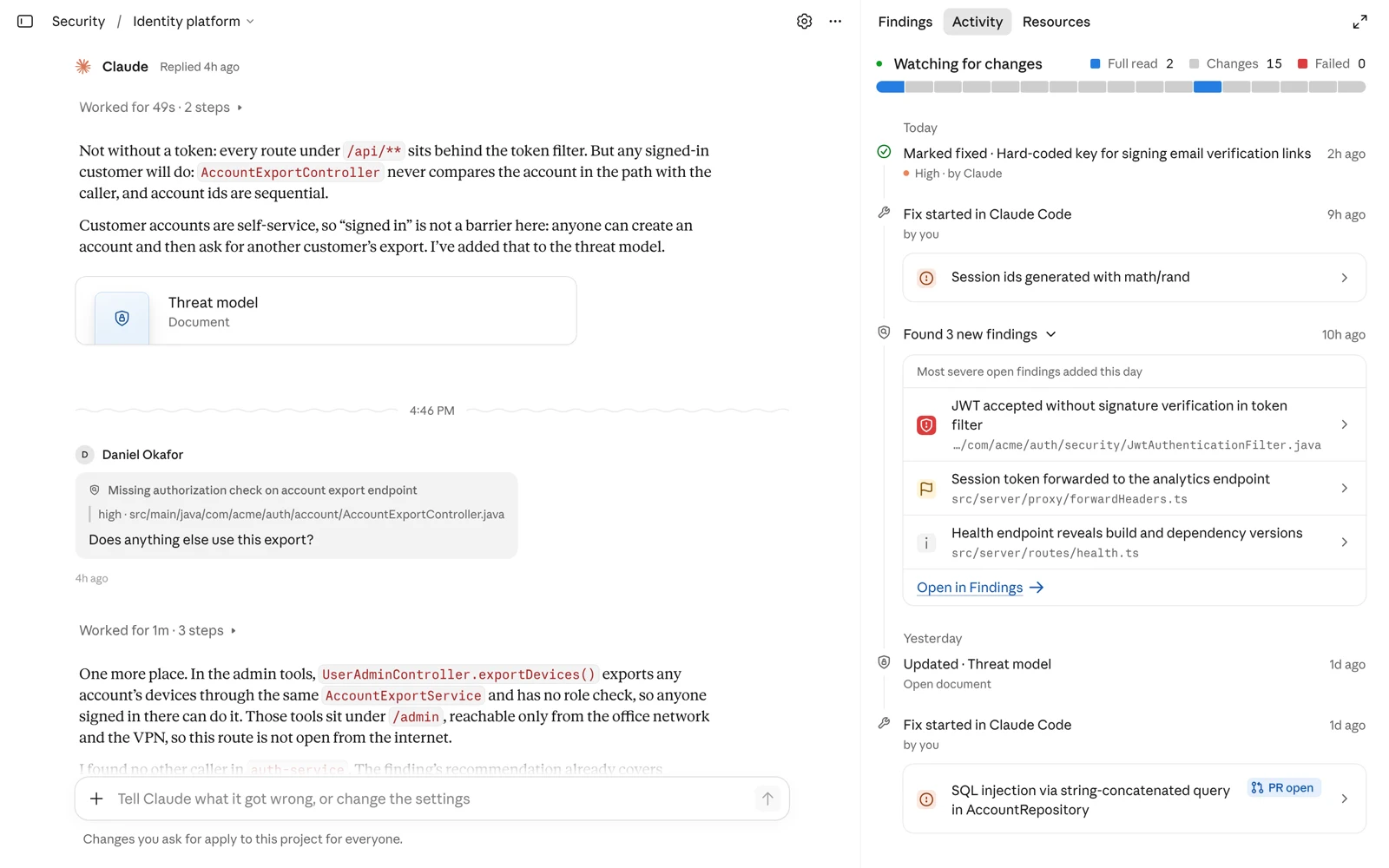
Claude Security adds ongoing scans and automatic fix tracking
Anthropic’s Enterprise security beta now follows code changes and connects findings to engineering tools through an API and MCP. Plan-specific access, usage billing and migration limits shape adoption.