Google announces Gemini 4 Carbon, with cyber defenders first
Google's phased rollout leaves broader access pending; Fairwind rules and benchmark conditions shape its practical use.
In this article
- Quick answers
- A new model, with access still being phased in
- Argon's broader release is the relevant comparison
- Fairwind selects organizations, rather than selling instant access
- The patching result has a narrower meaning than a headline ranking
- A model still needs a controlled repair workflow
- Token prices are announced; task economics remain open
- Sources & method
Quick answers
Who can apply to Fairwind?
Google prioritizes governments, critical infrastructure operators and core technology platforms, and welcomes defensive-benchmarking academic labs. Applications require vetting.
What does Carbon's patching score measure?
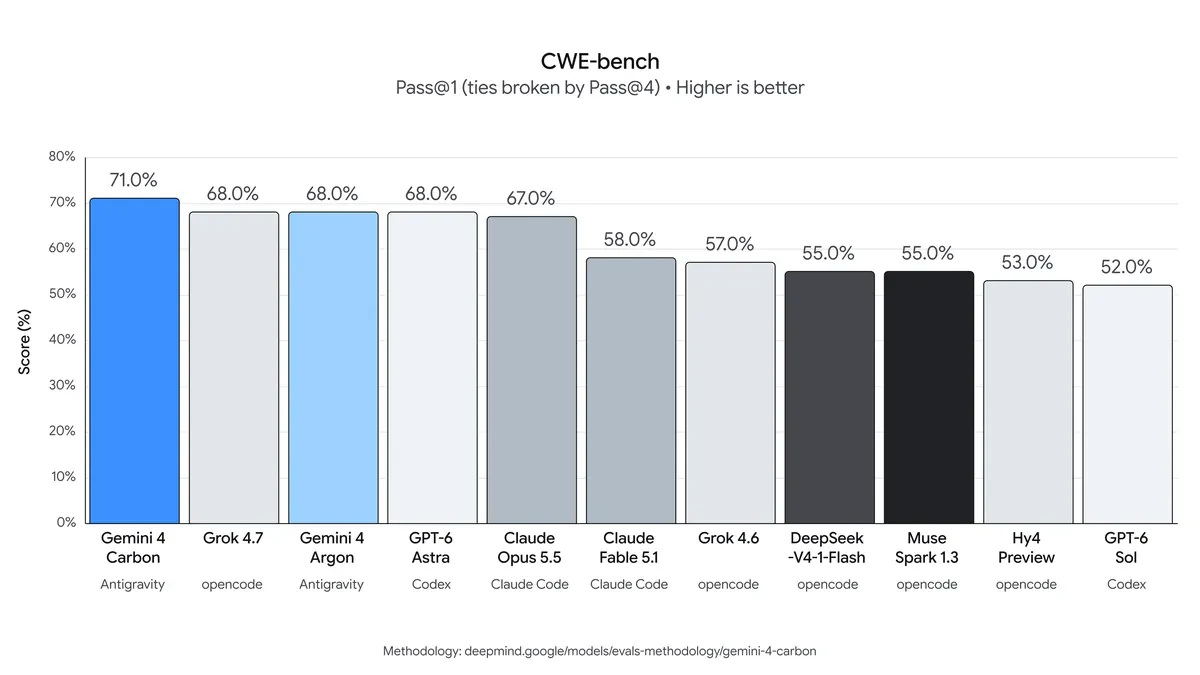
Collinear lists 71% programmatic pass@1 on CWE-bench v1. Its checks require blocking the exploit while preserving existing functionality.
The practical takeaway
Fairwind admission does not establish Carbon deployment details; patching scores and token rates also leave the cost of a completed repair unresolved.
A new model, with access still being phased in
Google announced Gemini 4 Carbon on October 28, with selected cyber defenders due to receive access this week through Fairwind. Broader availability remains forthcoming.
Argon's broader release is the relevant comparison
Two weeks earlier, Google announced Gemini 4 Argon's global rollout through several routes: the paid Gemini API for developers, Google AI Ultra access in Antigravity, and Pro or Ultra access in the Gemini app and AI Mode in Search. Its October 13 announcement also described a shared one-million-token input-and-output allowance and a continuation protocol for extended work.
Those were specific commitments about Argon. They cannot establish Carbon's API limits, supported interfaces or subscription eligibility. The practical distinction is between an available integration a team can assess and a newly announced model whose deployment details still need to be supplied. An existing Argon workflow should not be treated as an automatic Carbon migration.
Fairwind selects organizations, rather than selling instant access
Fairwind's public documentation still names Argon with cybersecurity defense capabilities, including in its technology description and model-specific access provisions. It explains the existing program, rather than providing a complete Carbon deployment specification.
The published rules prioritize governments, critical infrastructure and major technology platforms. Google vets applicants' security histories and ethical operations; academic labs working on defensive benchmarking may also apply. There is no promised application turnaround.
Participation brings controls as well as capability. The rules restrict dual-use work to authorized defensive or academic purposes, require phishing-resistant multifactor authentication and access controls, and prohibit partners from redistributing or selling model access. Our reading is that applicants must distinguish acceptance into Fairwind from confirmation of access to a particular model and configuration.
The patching result has a narrower meaning than a headline ranking
Collinear's CWE-bench v1 leaderboard lists Carbon with Antigravity at 71% programmatic pass@1, compared with Argon's 68%. The benchmark uses 120 private audit-and-patch tasks, four runs per task at high reasoning effort, and a one-hour limit per run. Pass@1 measures individual-run success, distinct from passing within four attempts. Its deterministic checks require the exploit to stop working and existing tests to pass.
An agent must investigate a repository without being told which vulnerabilities it contains, then repair it without breaking functionality. A plausible explanation of a bug is insufficient. Collinear reports no Carbon benchmark-run cost, so its leaderboard cannot yet establish the model's cost per repair.
SEC-bench Pro addresses vulnerability discovery and proof-of-concept generation in controlled targets. Its harness supplies a container and task metadata, runs an agent under a timeout and collects outputs for checking. Google reports 88.2% for Carbon, but the retrieved public table did not list it. Google says its cybersecurity evaluations ran without guardrails; those results do not establish performance under deployment safeguards.
A model still needs a controlled repair workflow
Google's existing CodeMender product illustrates the surrounding work. Its documentation describes scanning code, executing a proof of concept in customer-managed infrastructure, generating a patch and presenting a diff for developer approval. The reasoning and orchestration run in the cloud, while compilation, tests and exploit simulations run in local sandboxes or isolated virtual machines.
For example, a suspected injection flaw would need validation, a proposed change and checks that legitimate application behavior survives. This is an illustrative workflow, not a Carbon test. CodeMender's documentation says developers review and approve changes before committing them; a model's benchmark score does not replace that decision. The inspected product page did not identify Carbon as a supported model.
Token prices are announced; task economics remain open
Google specifies introductory Carbon rates of $2 per million input tokens and $10 per million output tokens, with cached inputs discounted 95%. Later rates are $4 and $20; no end date is stated.
Argon's separate announcement sets November 30, 2026 as the introductory deadline for its public-access model. That date should not be transferred to Carbon. More fundamentally, a token rate is only one part of a repair's economics: repeated attempts, tool execution and the work needed to approve the resulting change also matter. Without a Carbon task-cost result, the current evidence supports comparing technical performance more readily than forecasting a team's savings.
Sources & method
AI-assisted reporting from Google's announcements, program and product documentation, and benchmark publishers, with original analysis. We have not tested Carbon or verified access for any organization.
- Google: Gemini 4 Carbon: our next frontier modelPublished October 28, 2026
- Google: Gemini 4 Argon: Built to solve your hardest problemsPublished October 13, 2026
- Google DeepMind: Fairwind ProgramAccessed October 28, 2026
- Collinear AI: CWE-benchAccessed October 28, 2026
- SEC-bench Pro: benchmark and evaluation overviewAccessed October 28, 2026
- Google Cloud: CodeMenderAccessed October 28, 2026
Source pages reviewed October 28, 2026. Analysis and suggested evaluation methods are AI Toolcast’s own.
This article contains no sponsored placement or affiliate links.
Found a possible error? How to report a correction.
Keep reading
GPT-6.1 Terra cuts token prices; tool calls require Responses
OpenAI’s October 26 model targets visual work and computer tasks. Tool-using API applications need Responses, while long-context charges, cache writes and workspace restrictions qualify its cost and access story.
IBM expands Granite Speech with multilingual Turbo CTC and a new 2B model
IBM's October update adds Speech 5.0 2B, makes Turbo CTC multilingual and revises Plus. Language coverage, speaker labels and audio-processing limits differ across the downloadable models.
OlmoEarth v1.3 adds browser mapping with reusable satellite data
Ai2’s new release combines precomputed satellite features with a map explorer that requires no account. Annual coverage, local setup requirements and restrictions on permitted uses shape where it can be deployed.