
Google releases Elephant-Goldfish plugin to review AI coding plans
Google's open-source plugin separates design conversations from fresh-context reviews. Its documentation reveals host-specific limits, human approval steps and the maintenance work behind reusable specifications.
In this article
Quick answers
What did Google release?
An Apache 2.0 plugin that organizes AI-assisted design and specification review before implementation.
Which coding environments does it support?
The maintainers report automated workflow checks for Antigravity, Claude Code and Codex. Cowork and ChatGPT Work installation paths still have cloud trace verification gaps.
Does completing the process prove better code or faster delivery?
No. The project's FAQ warns that design review adds work and may not pay off for small changes. AI Toolcast has not tested its results.
The practical takeaway
EGM makes design decisions and review findings persistent, but useful adoption depends on isolated reviewer sessions, selective use and engineers resolving the findings.
A reviewable plan before generated code
Google announced the open-source Elephant-Goldfish Model plugin on October 22, packaging a process for drafting software specifications and having separate AI sessions challenge them before implementation. Developers get editable instructions, reviewer roles and coordinated review steps for their coding agents.
The practical change is a reusable workflow around the conversation. Its output is a written plan that another session can inspect, with engineers retaining responsibility for decisions. Google says the plugin originated internally; the public repository explicitly cautions that it is not an officially supported Google product.
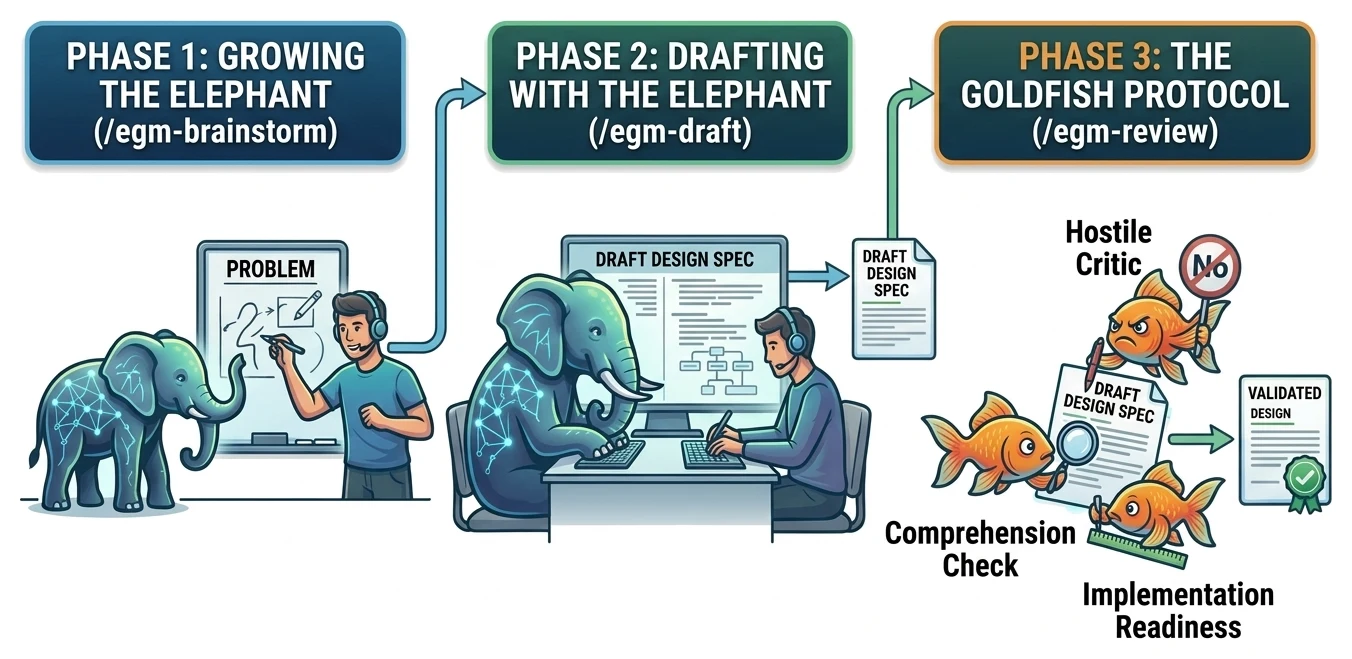
Why the reviewers start fresh
The project's animal names describe two different jobs. The Elephant session holds the project's background while exploring a design. Goldfish reviewers receive the specification and relevant source code without inheriting the conversation that produced it. Fresh context therefore does not mean reviewing without evidence.
Our reading is that this separation makes the document carry the reasoning a subsequent implementer will need. An assumption left only in a chat cannot help a reviewer who never saw that chat. That creates a useful test of whether the plan explains itself, although it does not make an AI critic infallible.
From an idea to implementation details
The workflow starts with brainstorming, converts the resulting concept into a Markdown design and then runs review. The architecture document describes four review stages: assess whether the approach is unnecessarily complicated, check comprehension, criticize the design and inspect implementation readiness. The final stage checks details such as file paths, function signatures and test cases.
Consider a hypothetical export feature. A design might explain which records users can download while omitting what happens when access changes during a long-running export. A separate reader could expose that missing decision before a coding agent implements the happy path. This illustrates the intended review mechanism; it is not a result from testing EGM.
Compatibility comes with conditions
The launch post emphasizes Antigravity and describes other environments as upcoming. The repository documentation inspected October 25 is broader: maintainers report automated installation, reviewer-isolation and workflow checks for Antigravity, Claude Code and Codex. Claude Cowork and ChatGPT Work have installation paths but retain gaps in verifying cloud execution traces. These are the project's reports, not installations we verified.
The host must expose a way to launch a reviewer with fresh context. Without it, the documented review skills stop instead of substituting a critique inside the original conversation. The guide also warns that copying only the skills directory breaks the plugin: reviewer definitions and document standards are required at runtime.
The design remains part of the project
EGM's setup guide describes an implementation handoff through a design pull request reviewed by another person. Engineers decide which AI findings deserve action. The specification then tells the coding agent what to build; teams still supply their own testing, style and implementation practices.
The package also addresses existing projects. Its bootstrap skill builds documentation from lower-level directories upward, while a drift-report skill compares specifications with referenced code. When they diverge, a person chooses whether to change the implementation or the document. The benefit proposed here is durable project memory, but keeping that memory accurate becomes an explicit maintenance task.
Open source does not establish a productivity gain
The Apache 2.0 license permits use and redistribution under its conditions without a plugin royalty. That is a licensing statement, not a promise of free model execution. The inspected release materials do not establish a per-review operating price or universal host-plan eligibility, and we have not measured token consumption.
The project's FAQ acknowledges the tradeoff: more documentation can overload reviewers, and design work may not repay its cost for a small, well-understood change. It recommends prioritizing consequential work and comparing total effort, useful findings and rework. That makes EGM most interesting as a structured way to resolve uncertain decisions before coding. Completing its stages alone does not demonstrate faster delivery or fewer defects.
Sources & method
AI-assisted reporting from Google's announcement and the project's repository, implementation guides and license, accessed October 25. Documentation describes intended behavior and maintainer-reported checks; we did not install the plugin, test its reviews or measure costs or productivity.
- Google: Introducing the Elephant-Goldfish Model pluginPublished October 22, 2026
- Google: Elephant-Goldfish Model repositoryAccessed October 25, 2026
- Elephant-Goldfish Model: Harnesses and support statusAccessed October 25, 2026
- Elephant-Goldfish Model: Setup and workflow guideAccessed October 25, 2026
- Elephant-Goldfish Model: Architecture and system lifecyclePublished June 6, 2026
- Elephant-Goldfish Model: Apache 2.0 licenseAccessed October 25, 2026
- Elephant-Goldfish Model: Project overviewAccessed October 25, 2026
- Elephant-Goldfish Model: FAQAccessed October 25, 2026
Source pages reviewed October 25, 2026. Analysis and suggested evaluation methods are AI Toolcast’s own.
AI Toolcast has not tested this plugin. This article uses AI-assisted research and writing and is not sponsored; it contains no affiliate links.
Found a possible error? How to report a correction.
Keep reading
Resend Inboxes adds shared email for agents, with setup and permission limits
Resend’s new inboxes combine conversations, team handoffs and agent controls. Its documentation adds consequential details: hosted-only MCP support for inbox tools, a forwarding option and different permissions for reading and sending.
NVIDIA adds document-image search to Nemotron 3.5 retrieval models
NVIDIA’s downloadable Embed and Rerank models extend search across text and document images. Existing text-index compatibility offers a migration path, while the smaller NVFP4 version carries specific hardware and runtime requirements.
Exa 3.0 adds cheaper agent search, with cached-content limits
Exa’s October 19 release adds Lite search and expands the information available to AI agents. Its implementation guides reveal limits on fresh page retrieval, clearer search warnings and a documentation mismatch over Dynamic Highlights.