Gemini Robotics ER 2 reaches public preview on Google Cloud
Google opens its Cloud route to the robotics reasoning model. The preview brings project-based access, but streaming support differs from the Developer API and introductory prices depend on credits.
In this article
- Quick answers
- An existing model gets a wider Cloud entry point
- From a visual instruction to calls into robot software
- Video analysis and live streaming are different capabilities
- Cloud credentials, a global endpoint and preview conditions
- The introductory prices depend on credits
- Deployment responsibility stays with the operator
- Sources & method
Quick answers
What changed on October 27?
Gemini Robotics ER 2 moved from private to public preview on Google Cloud. The model had already launched through the Gemini API and Google AI Studio in July.
Does the Cloud preview support live streaming?
The Cloud model specification lists Gemini Live API as unsupported. Google's separate Developer API offers an ER 2 streaming model, so the two access routes are not interchangeable.
What are the introductory usage rates?
Google lists $1 per million input tokens and $5 per million response-and-reasoning tokens through December 31, 2026, with cached input at $0.10. A footnote says the promotion operates through 50% credits back on net spend.
The practical takeaway
The public Cloud preview broadens access to an existing robotics model, with a different API feature set from its Developer API counterpart.
An existing model gets a wider Cloud entry point
Google opened Gemini Robotics ER 2 to public preview on Google Cloud on October 27, giving developers and enterprise teams a broader route to its model for interpreting scenes and planning robot tasks. The release makes it available through Model Garden with Cloud identity controls and project-based access.
The change is in access, rather than a new model generation. Google introduced ER 2 on July 30, when its announcement described public availability through the Gemini API and Google AI Studio, alongside a private preview on the enterprise platform. Today's release opens that previously limited Cloud route.
For organizations already managing robotics infrastructure in Google Cloud, the practical attraction is bringing this reasoning component into their existing cloud environment. The preview still leaves the robot's control software and physical safeguards to the deployment team.
From a visual instruction to calls into robot software
ER 2 works above the machinery that moves a robot. It interprets the scene, decides which steps to attempt and calls tools supplied by the developer. Google's July description explicitly separates this planning role from motor execution handled by lower-level action models.
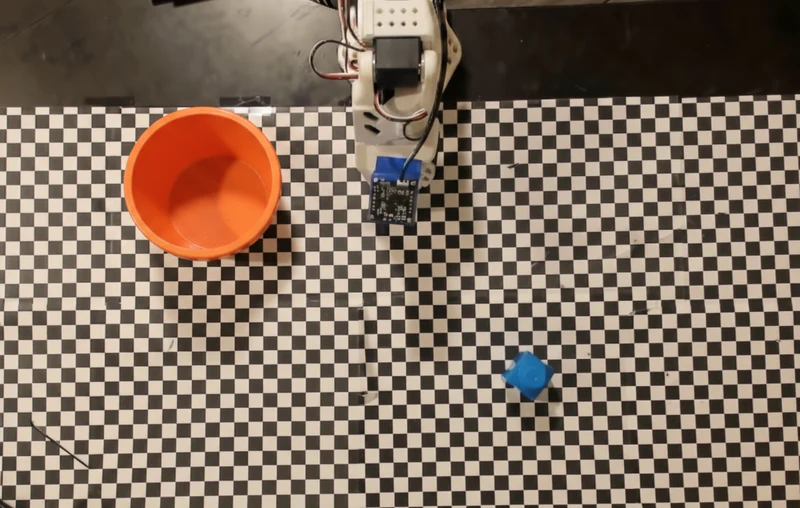
The Cloud task-orchestration guide makes that boundary concrete. Its example asks for a blue block to be placed in an orange bowl, exposing functions for arm movement and opening or closing a gripper. An application loop executes requested calls, returns their results to the model and continues until calls stop or a step limit is reached.
This is a mock robot API: the supplied functions print actions. The example demonstrates how software connects a model's decisions to controls; it does not demonstrate a successful physical pickup. Turning it into a working installation requires implementing those functions for actual hardware.
Video analysis and live streaming are different capabilities
The video guide describes two useful checks: finding the time a task finishes and estimating how far it has progressed. Its completion example asks for a timestamp or a null value if the task remains unfinished. Another example assigns the final video frame to one of five progress brackets. Both send video files through a request, illustrating how an application can ask about observed work.
That does not establish a live streaming connection on Cloud. The Cloud model specification supports GenerateContent but lists Gemini Live API as unsupported. By contrast, the Developer API documents a separate gemini-robotics-er-2-streaming-preview endpoint for continuous audio and video. A developer moving a streaming application to Cloud therefore cannot assume the same interface is available.
Cloud credentials, a global endpoint and preview conditions
The Cloud setup guide uses Google Cloud credentials rather than a Gemini API key. Its SDK examples select a project and the global location. The model page also requires billing and the Agent Platform API to be enabled for its example-app deployment.
The preview's listed serving location is global, with no regional endpoint offered in the documentation. Standard pay-as-you-go consumption is supported; batch inference, provisioned throughput and model tuning are not. Those restrictions matter when choosing how to run repeated video analysis or reserve capacity.
Google's documentation permits production or commercial use subject to the applicable agreement, while warning that pre-general-availability features are supplied as is and may have limited support. Public preview should not be read as general availability.
The introductory prices depend on credits
Google's pricing table lists ER 2 input at $1 per million tokens and text output, including reasoning, at $5 per million through December 31, 2026. Cached input is listed at $0.10 per million. The table's footnote says promotional pricing is provided through 50% credits back on net spend on selected models within a given period.
That mechanism matters for budgeting: the displayed promotional rates should not be described as an unconditional upfront discount. Starting January 1, 2027, the table lists $2 for input, $10 for output and $0.20 for cached input. These are model-token prices, not the total cost of operating a robot or its surrounding infrastructure.
Deployment responsibility stays with the operator
The overview warns that the model can produce incorrect answers and that higher-resolution inputs or increased reasoning can add latency. It places responsibility for a safe operating environment on the robot operator.
Its privacy notice also requires sufficient notice and consent before identifiable people interact with, or are present around, a deployment that collects their personal data. It calls for reasonable efforts to minimize that collection, including face blurring where practicable. Those requirements make camera placement and who can enter the workspace part of the implementation, alongside the API integration.
Sources & method
AI-assisted reporting from Google's announcements, implementation guides and pricing documentation, with original analysis. We have not run the model, operated a robot or independently verified Google's performance claims.
- Google Cloud: Gemini Robotics Embodied Reasoning 2 is now available on Google CloudPublished October 27, 2026
- Google DeepMind: Introducing Gemini Robotics ER 2Published July 30, 2026
- Google Cloud: Gemini Robotics ER 2 overviewPublished October 27, 2026
- Google Cloud: Gemini Robotics ER 2 model informationPublished October 27, 2026
- Google AI for Developers: Gemini Robotics ERPublished October 26, 2026
- Google Cloud: Agent Platform pricing — Gemini RoboticsAccessed October 27, 2026
- Google Cloud: Robotics task orchestrationPublished October 27, 2026
- Google Cloud: Robotics video understandingPublished October 27, 2026
- Creative Commons: Attribution 4.0 InternationalAccessed October 27, 2026
Source pages reviewed October 27, 2026. Analysis and suggested evaluation methods are AI Toolcast’s own.
This article contains no sponsored placement or affiliate links.
Found a possible error? How to report a correction.
Keep reading
GitHub Copilot makes AI-assisted permission checks generally available
Copilot can delegate eligible permission decisions to a model across three developer interfaces. Automation flags, session limits and conflicting enterprise guidance shape its use.
GitHub combines Copilot and notifications in its Teams app
The consolidation comes with a November 16 retirement deadline. Sandbox requirements, thread capture and separate cloud charges make the migration more than an app rename.
Claude adds an Anthropic-managed Google Cloud option for agent tools
Anthropic's new access route brings Claude Platform features to Google Cloud customers. The implementation guides reveal separate account setup, regional pricing and agent controls behind the shared cloud bill.